Starship Campus
Care Package

Project Overview
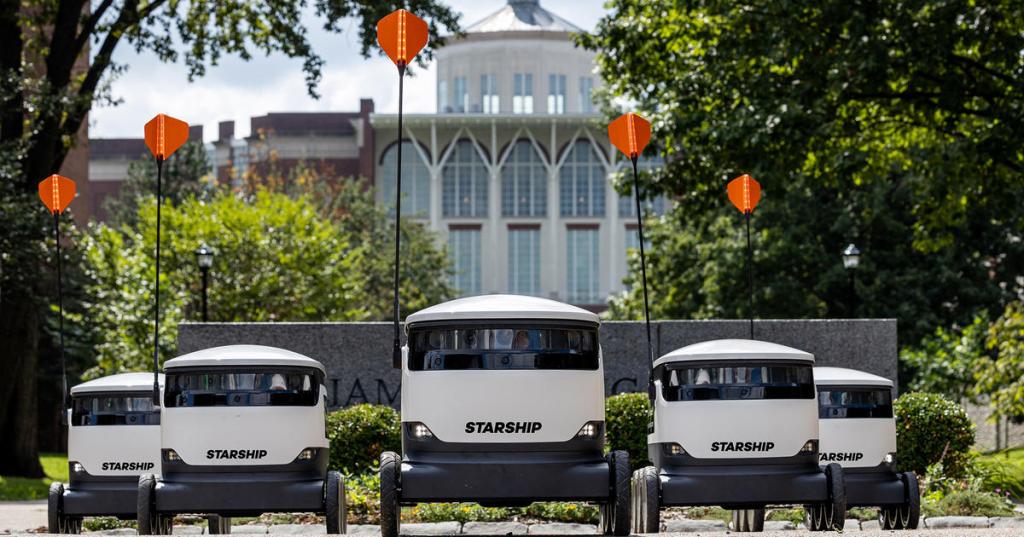
Purdue has a fleet of ~60 running Starship robots which are currently used to deliver food ordered at campus dining services to hungry Purdue students. What else can a Starship do? In this project we had to find a new use for Starship that involved the use of human-human connection.
.
Our Focus
My team’s task was to reimagine the use of Starships with a concentration on human-human interaction. Throughout our brainstorming process we identified many ideas that could help expand the use of Starship’s. One idea in particular stood out to us, Starship Campus Care Package .
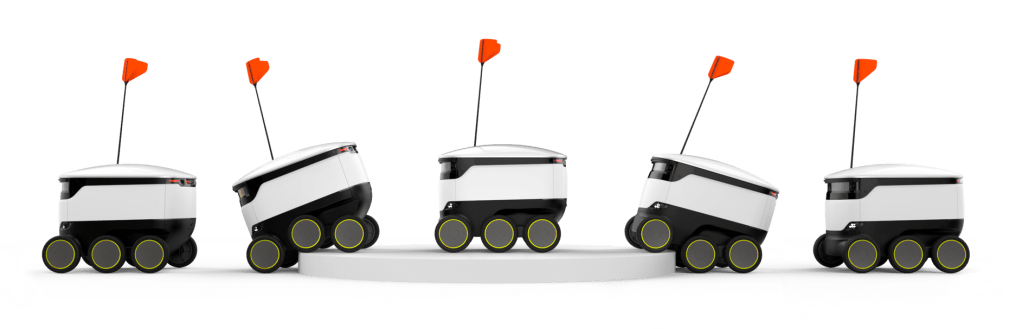
What Is the Starship Campus Care Package?
The Starship Campus Care Package is a multi-pickup service utilizing Starships for sick, first year Purdue student’s. This service will provide Purdue students with the necessary tools to combat common illnesses found on college campuses while still giving them the sense of connection with their peers while ill.
Initial Storyboard
First storyboard outlining how a Starship might deliver to a sick, first year, Purdue Student using the multi-stop pickup method.
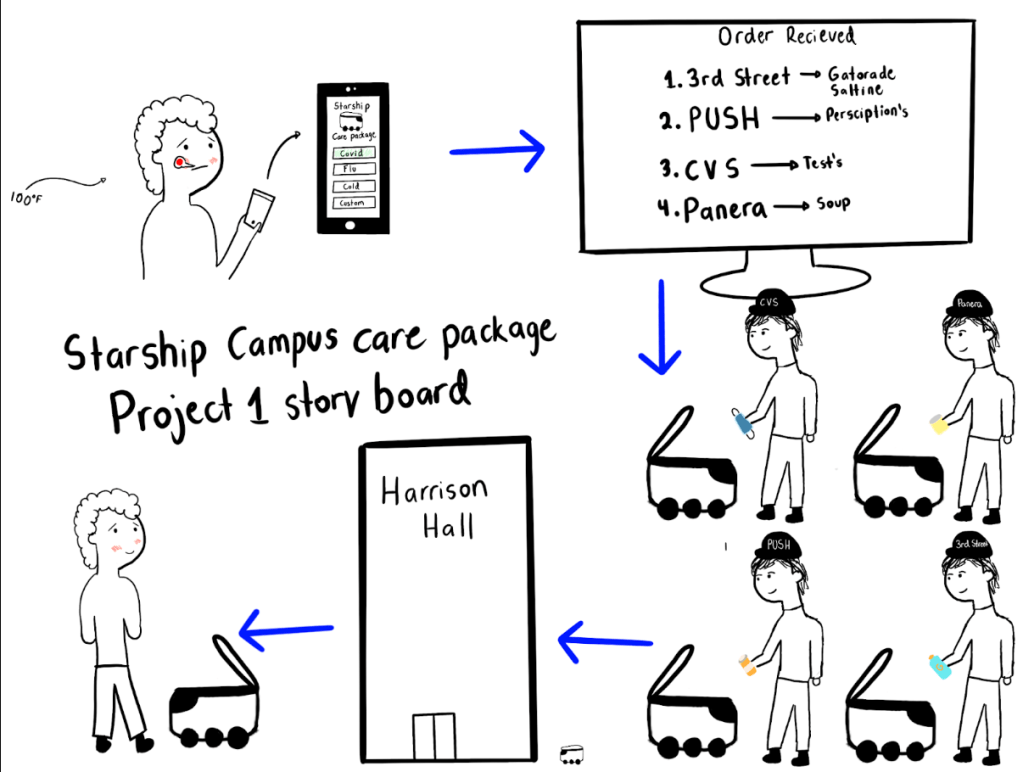
Storyboard illustration created by Madi Loyd
Interview’s and Finding’s
Although we had arrived to our idea fairly quickly, we conducted 7 interviews to ensure the Campus Care Packages would be considered an asset by our user group. We also learned about the pre-existing function of Starship on Purdue’s campus today.
All Purdue student interviewees expressed enthusiasm when presented with our idea of Campus Care Packages, as it broadens Starship’s appeal and target market. Additionally, many mentioned the common action of reaching out to their parents when feeling unwell, thus emphasizing the perceived value of the care packages.
However, there are concerns when it comes to technical glitches and safety issues. A few of our interviewees were worried about delivery fees, with students expressing a reluctance to spend more than approximately $5 extra for delivery.
Midpoint Critique & Evaluation
After presenting our Campus Care Package idea to our peer’s, my group received valuable feedback and concerns that we did not originally consider in our design.
.
Likes
- Likes the pre-made care packages for most common illnesses.
- Likes how the care packages can be customizable to the user’s liking
- Likes how everything can be delivered in one Starship
- Likes the inclusion of the care card to help instruct students how to use items included into the package to help them heal
Suggestions
- Security concern for the Starships making sure they don’t get lost or stolen, specifically for the medication.
- Increasing the human-to-human interaction between the robots and the students.
- Concern about age requirements to purchase specific medications such as day/nyquil, where you must be 18 years old to purchase.
Scenario Storyboard
After presenting the Campus Care Package idea to our peer’s, my group received valuable feedback and concerns we did not originally consider in our design. My group came up with a scenario regarding an ill, first year Purdue student and his course of action in receiving a care package.
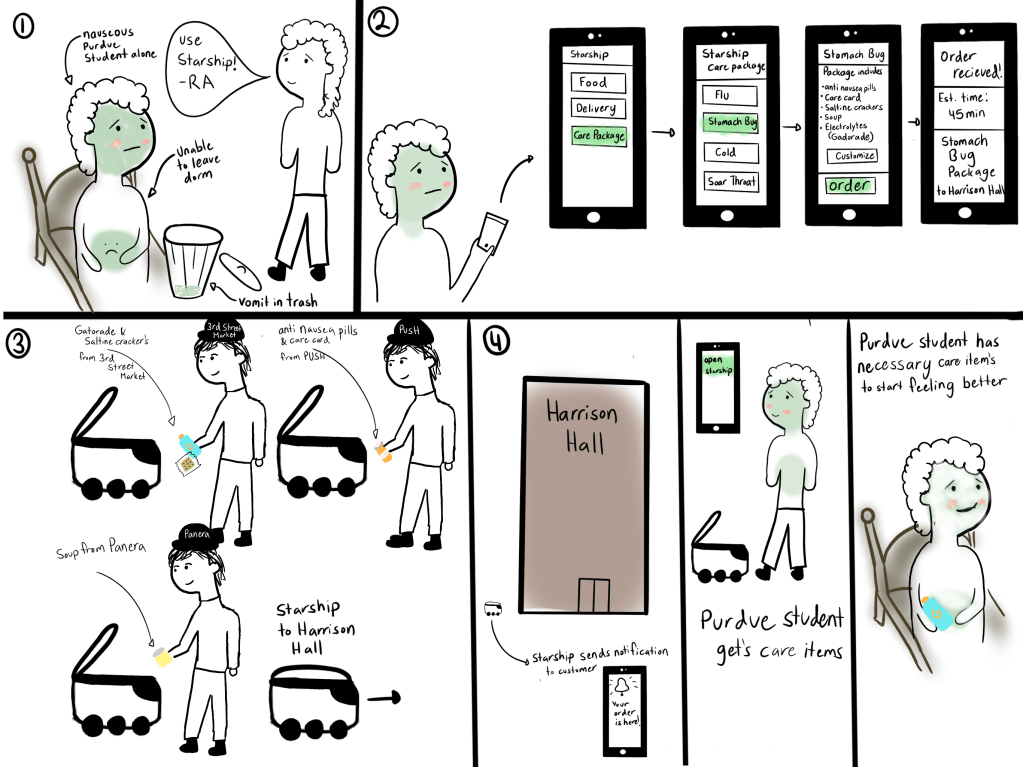
Storyboard illustration created by Madi Loyd
.
Addressing the Concerns
From the peer review, multiple people addressed the security concern for the Starships making sure they don’t get lost or stolen, especially if medication is included in the care package. Our solution for this concern is to add cameras or separate compartments for each item within the Starships.
The main critical insight we had uncovered was the goal of increasing the human-to-human interaction between the robots and the students. We added a QR code to the Starships so students can scan the code and send messages to the sick students.
In our final presentation, there was a concern about age requirements to purchase specific medications such as day/nyquil, where you must be 18 years old to purchase. Through this critique, we came up with the idea that, when making a Starship profile on the app, you must put your age, to ensure that this application is following legal guidelines.
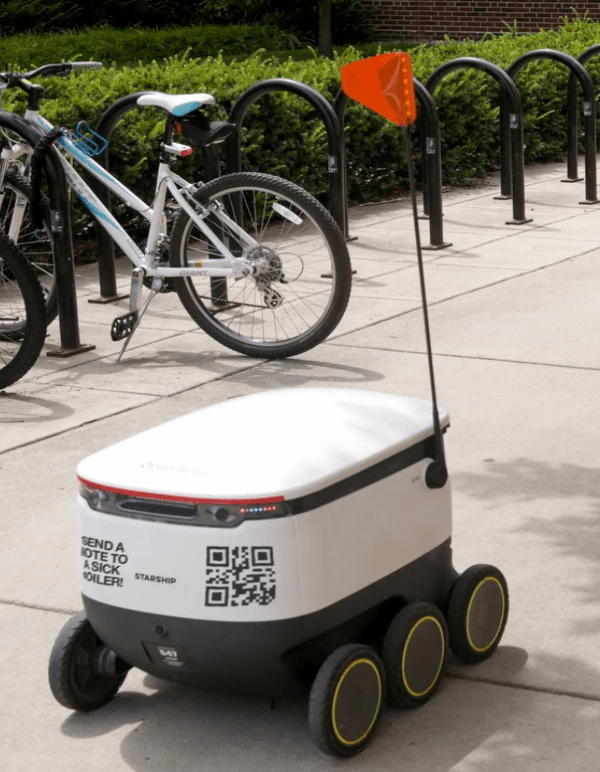
Human-human QR Code to send messages
Human-Human Mockup
Here is our mock-up utilizing the human-human QR code element allowing Purdue students to feel connected to campus and their peers while ill.
Mockup created by Kimberly Hung
Summary/Reflection
This project has provided a comprehensive analysis of how sick, first-year Purdue students often struggle to know how to take care of themselves in a way that protects the people around them. Through primary research, secondary research, analysis, and collaboration, we have identified viable solutions to address the issue at hand while innovating the use of Starships. By taking proactive steps to implement the proposed solutions, my group and I can work towards a future where sick, first year Purdue students can get better, quicker and limit the transmission of diseases to protect Purdue. Through collaboration, innovation, and dedication, we will be able to overcome challenges and create a more resilient and prosperous environment for everyone to have access to medical supplies when sick.
Personal Contributions
My contribution to this team effort in bringing our Starship design to life was a combination of leadership, being present for every class meeting, and leading discussions in relation to our design. I helped develop my team’s idea of care packages in the early stage’s of this project. Along with the development, I conducted two interviews which provided helpful insight that brought to light valuable things to consider in our project. I aided in compiling and synthesized our group’s findings as well as illustrating the two storyboard’s listed above.
Thank you!
Let’s Get in Touch!
(765) 426-5691
madiloyd@icloud.com
 madiloyd.com